Tuesday, July 26, 2011

Carnegie Library, Dunfermline, Scotland

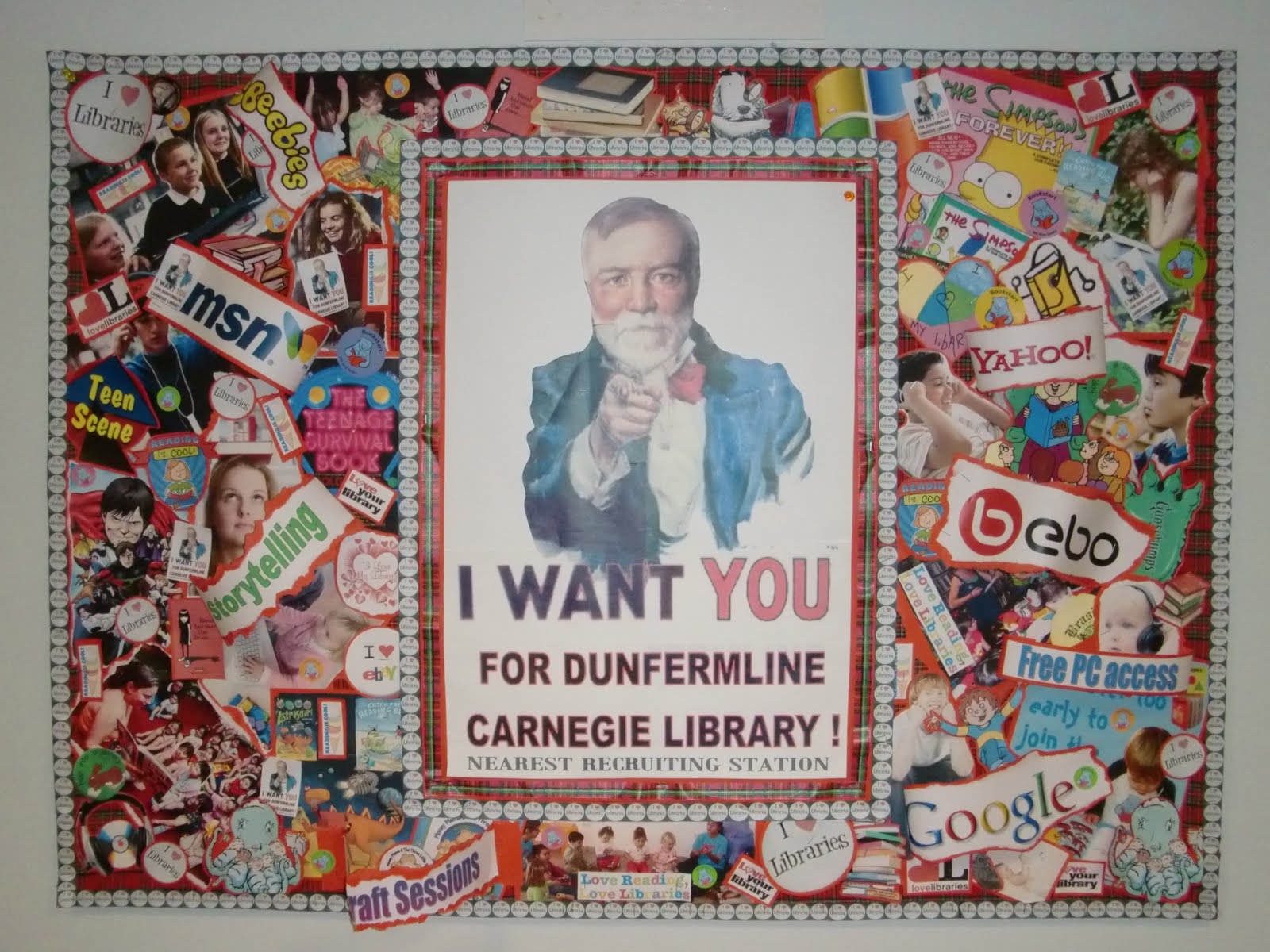
Dunfermline was the birthplace of Andrew Carnegie. The Carnegie Library there was the first one to be gifted by him. J.C. Walker designed the building and it was opened to the public on the 29th of August 1883. In the entrance hall of the building there is a bust of Carnegie’s mother. The library provides free Internet access to its users and the collection holds about 59,000 materials. The special collections include the Murison Burns Collection and the George Reid Collection of Medieval Manuscripts and early printed books.

In 1992 the museum expanded and opened a children’s section. The library offers “Rhyme Time” for toddlers and a summer reading program for school aged children. This year they had 139 children signed up for the summer reading program.

The library has a local history room. Items there are shelved by general subject, and then by specific areas of that general topic. They include family history research materials from 1561 to 1700 birth and marriage records. In the back room they have many items in storage including a gifted donation of glass negatives and accompanied handwritten indexes by local photographer Morris Allan, maps of Dunfermline, the 1851 to 1950 bound hard copies of the Dunfermline Journal, and the Scriptures of Saint Margaret Gospel (the other existing copy is in the Bodleian Library in Oxford).

A new museum and gallery is expected to open in Dunfermline by 2015. It will be an integrated facility with the Carnegie Library. Of course this is all dependent upon available money from the heritage fund.

Central Library, George IV Bridge, Edinburgh

Central Library of Edinburgh is a Carnegie Library and opened its doors to the public in 1890. The architect George Washington Browne designed it in the French Renaissance style. Above the entrance there is a quote that reads “Let there be light.” Apparently, Andrew Carnegie insisted that this quote be inscribed in the entrances of all the Carnegie libraries. Today the library has two floors below ground, and a lending library, resource center, and learning center on the ground floor. On the first level above the ground floor is the Board Room, and on the second level there is the reference library and fine art library.

This library has a 24/7 online presence. The librarians attribute its increased membership to the continual online availability. On the website users can get information about the twenty-seven community libraries and their services. The library’s goal is to make the entire collection accessible, or into a virtual library. On the homepage there is a link to online services and resources e.g. language learning, businesses, funding, and ancestry. The library’s use of social media can be found in “A Tale of One’s City” on Twitter, YouTube, or the Flikr Channel. The librarians maintain a blog and a quarterly E-newsletter that serves about 1,000 people. Library 2GO provides E-books and E-Audio books online. The overall goal is to increase the use of the library’s resources and collections.

The library does a great deal of outreach and marketing to its users and potential users. It provides author events where authors come to the library and branch libraries to promote their books. They create book clubs/groups and promote readers to read outside of their preferred genre. There are about thirty library volunteers who visit “carehomes” and read poetry and other genres to the residents there. The library has also formed partnerships with other literary organizations such as the Scottish Storytelling Center and the annual Book Festival each August.

The library also provides classes to teach computer literacy, literacy, and numeracy. The computer literacy lessons are informal and usually last for six weeks. The learners are matched up with a buddy and work one on one with that person. The learning center also works with Dyslexia of Scotland and provides support for children and adults with dyslexia.

National Records of Scotland

The National Records of Scotland is the consolidation of the National Archives of Scotland and the General Register Office for Scotland. In 1789 the building was opened to the public. There are 450 staff, six public search rooms, and nine websites. The collection contains seventy-two kilometers of historical records, dating from the 12th century. It contains the Scottish register of births, marriages and deaths, as well as the Scottish Census records since 1841. The bound records are color-coded: black for death, red/maroon for birth, green for marriage. Only the most requested records get priority to be digitized, thereby determined by user requests. The oldest document is a brieve (the land the king granted for a church) from King David I from the 1120s. Also available are the digitized wills of the Scottish people that date from 1501 to 1901.

Online service provided by the NSR include the following:

Scottish Archive Network: 45 archives

Scotlandspeople genealogical information, old parish registers, catholic registers, coats of arms,

Scotlandsplaces- maps, plans, aerial photos, geographical data

Scottish register of tartans

Scottish Handwriting.com paleography

Scottish Archives for Schools e.g. Glow (teacher resources/training)

Most of the National Records of Scotland users are from the older generation, say in the fifties and older, or professionals. The use of the records tends to increase with the airing of television shows regarding genealogy such as “Who Do You Think You Are?” Although the digital copies of records are available in house, they aren’t yet available online.

Wednesday, July 20, 2011

The Christ Church Library, Oxford, England

The Christ Church Library was originally housed in the cloisters until 1772 when it was moved to his current location. The collection is organized by the name of the person who donated it, e.g. Aldrich, Stratford, and Wake. In the collection you will find first edition books by Copernicus and Galileo, Roman Scripts produced in England circa 550 to 1163, a 1326 illuminated manuscript for Edward III, eighty-six Byzantium Manuscripts from the ninth, tenth, and eleventh centuries. There are also illuminated Hebrew manuscripts, and about forty Arabic manuscripts. Additionally, the library has a collection of Lewis Carol’s work e.g. Alice and Wonderland.

The users can access the collection by making an appointment. They can get copies of Medieval and Renaissance manuscripts that are online in pdf form. In the future, the library will be getting a digital studio to prepare metadata for online availability.

The Bodleian Library, Oxford University

The Oxford University’s first library was established in 1320. It consisted of two floors and took the master builder fifteen years to finish. The collection started with the donation made by Duke Humfrey of Gloucester. The collection grew and the library was considered completed by 1488. However, during the Reformation under the rule of Henry VIII, the collection was destroyed except for three books that survived. Along came Thomas Bodley, a protestant, graduate of Magdalene College, and a fellow, later in life left his personal library to Oxford University, hence the name the Bodleian Library. In 1610 Bodley made arrangements with publishers to ensure the library received one copy of every book published in Britain at that time. Currently there are eleven million books in the collection. It is not a lending library and only librarians can retrieve the books from the shelves. Many books in the collection are on microfische. However every college within Oxford University has a lending library.

An additional library to the campus is called the Radcliffe Camera. Originally it was a medical library established by Francis Smith of Warwick and Dr. John Radcliffe. The building itself is quite remarkable. It is a round, multi-storied structure with a domed roof that floods the interior with natural lighting.

The Royal Geographic Society

The Royal Geographic Society’s librarian, Eugene Raye, led our group into the Foyle Reading Room to look at items from the “Hot & Cold” explorers’ collection. The “hot” part of the collection was from explorers that went to places near the equator such as those looking for the source of the Nile or mapping the Amazon. The “cold” part of the collection was from explorers trying to find the Northwest Passage, the North Pole, or the South Pole.

First we looked at the items from the “cold” part of the collection. The items included here were from the 1840s Perry expedition to the North Pole, e.g. Inuit shoes, and the fatal 1846 Sir John Franklin arctic expedition. From the Antarctic region there are items from Captain Scott’s Discovery Expedition, e.g. a supply list from Harrods Store limited and a food bag. Also included were items from Shackleton’s expeditions e.g. Shackleton’s bible, and an edition of the “South Polar Times” magazine, as well as photographs of the Endurance trapped in ice by the photographer Frank Hurley.

Recent items donated to the “cold” collection came from the contents of Mallory's pockets when Mt. Everest climbers discovered his remains in 1999. These items include a wristwatch, compass, Swan matches, and energy sweets. These were added to the Mallory collection that includes the planning papers for the expedition to the summit of Mt. Everest, photographs and a metal water bottle. Mallory’s camera has yet to be recuperated.

Next we looked at the artifacts from the “hot” collection. First we looked at items from Livingstone’s expedition to find the source of the Nile e.g. a sketch of Victoria Falls, a sketch map of the area, and Livingstone’s hat and compass. Included in this part of the collection is Henry Morgan Stanley’s hat. From the Amazon part of the collection, we saw Percy Fawcett’s artifacts. These included photographs, hand made maps, and an anode barometer. Included in this part of the collection is T.E. Lawrence’s sketch map of Arabia, and a replica bust of Gertrude Bell, the original is in Bagdad, Iraq. For good measure, the box sextant used by Charles Darwin when he was on the voyage of the Beagle was also on the table.

Overall, the library holds two miles of items including one mile of maps, and half a mile of photographs all stored in the archives beneath the city block. All of the items are onsite and retrievable within five to ten minutes time. In 2004 the online catalog was created. Unless users are members or people in education there is a ten-pound fee to use the reading room and access the collection.

National Art Library, Victoria & Albert Museum

The National Art Library was established in 1837 and was part of the School of Design. Since that time it has been moved to different locations in London from its original site at Marlborough House, next to Somerset House, and then in 1850 to its current location. It is a non-lending library so all research needs to be done in house. The reference room materials are open access otherwise the stacks are closed and materials must be requested with the limit of six items per request, unless they’re from special collections in which case the limit is three items. In the periodical room there are 8,000 titles including 2,000 current titles. This collection is related to the museum collection of Arts & Crafts, for example the library holds 99.9% of all Vogue magazines ever published in both English and French. They are bound for security and preservation. The collection also includes trade and exhibition catalogs dating from the 18th century to the present.

The books are classified and ordered by size. It is a historic collection therefore there isn’t a logical classification system. In order to find items the librarians use a locator map, pressmarks on the books and a findings list. The annual acquisition budget is about $300,000.

My favorite part of the tour was when we were led into a room with items from the collection on display. The librarian, Sally Williams, explained the background information about the items she’d pulled for discussion and our perusal. The collection includes a 1908 illustrated fashion design book by the then famous designer Paul Poiret. The illustrations were made with stencils and then colored in. Next there was an art book that had rabbit pelt pages. The oldest item on display was an illuminated manuscript from Paris dated 1410. There was the original manuscript of Charles Dickens’ David Copperfield that had been donated by John Forster in 1876. The library also holds a copy of John Audobon’s 450 prints bound in a book. There was a preserved copy of Ross & Sons Great Exhibition Almanac of 1851. It was so exciting to be able to handle and go through these materials.

Due to the lack of funding very few items in the library’s collection are digitized. However, there are a select few items available on the database Empire online.

Most of the users of this library are university students, post-graduates, people related to auction houses, and curators at the museum. The users have free access to the database including JSTOR. There are also student theses available from the library by date.